


As a girl, Maryann Proper Barto spent hours in the yard of her family home on Route 82 in West Taghkanic, watching her mother weave thin strips of wood into baskets used to collect everything from eggs, fruit, and pies to clothespins and mail.
Her mom, Elizabeth Proper, was the last of the region’s basketmakers when she died in 1996. Some longtime residents still remember the front porch of the house, which no longer stands, lined with her handiwork.
Maryann, who now lives in Clinton County, N.Y., with her husband, Leo Barto, returned to the area on Sept. 26 to talk about her mother’s craft at Gallatin Town Hall. About 30 people gathered on a Saturday morning to listen to her story in an event organized by Town Historian Louisa Ruby.
Although she hasn’t continued the tradition herself, Maryann believes it deserves to be remembered. “Why should it die off? Why should it become forgotten?” she asked. “It’s part of our history. It’s part of our world. It’s part of that region.”
Elizabeth began making baskets when she was 13, in 1948, the same year her mother died. That left her as the oldest “woman” in a household of men. Her uncles and grandfather suddenly expected Elizabeth to do all the household chores, Maryann said — a role her mother did not enjoy.
“I think [making baskets] was her way of speaking out at the time,” Maryann said. “No, I don’t have to do this, I’m going to do this. And she did it in secret to a point when she was a kid.”
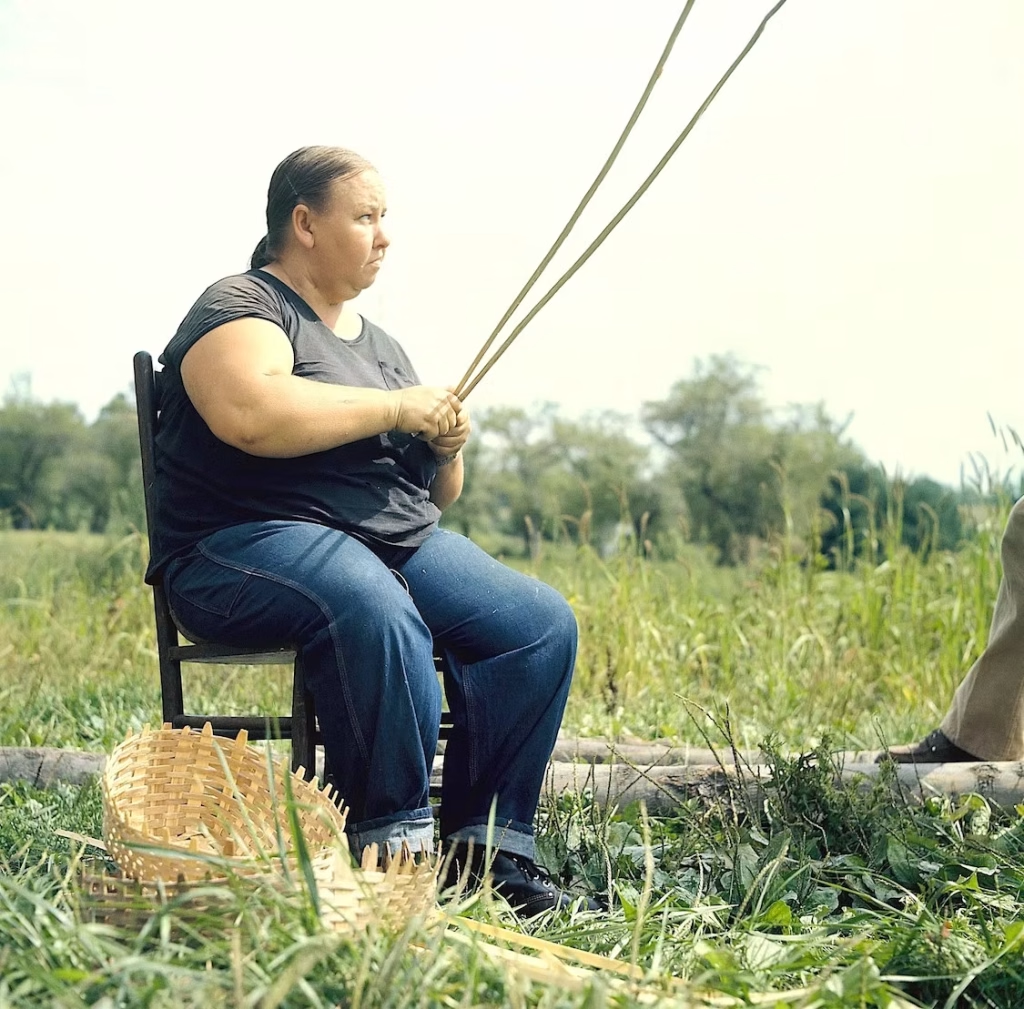
Elizabeth’s ancestors, who came from Germany, had lived in harmony with Native Americans in the region, Maryann said, and it is likely that she learned how to make baskets from them.
When she turned 18, Elizabeth started working with horses, and she later became a logger. But once she had Maryann, she went back to making baskets. Her daughter often rode along as Elizabeth asked landowners about trees they might let her cut for her work.
Elizabeth primarily used black ash, white oak, and hickory, and looked for trunks that were 4 to 8 inches in diameter. She would strip the bark with a jackknife, then pound the wood with a hammer until it separated along its growth rings. After removing splinters, Elizabeth used a pocket knife to cut the wood into strips, which she soaked for a couple of hours in a tub of warm water to make them pliable.
She began each basket at the center of the bottom and wove around. The whole process took about 18 hours, Maryann said.
In addition to shopping and storage baskets, Elizabeth also made bassinets and special friendship baskets that had two thin handles joined together, as if in an embrace.
“I would see my mother create something, and people would just use it in their daily lives,” Maryann said. “It brought joy to them. They respected it. They saw the importance of it. Whether it was the farmer’s wife gathering eggs, or it was a garden basket, the basket was timeless.”
For many years, her mother made a living by selling her work to customers from all over Columbia County, Maryann said. Most baskets cost $10 to $15, while her sets of 10 to 12 nesting baskets could go for $1,000.

Watching her mother live her life on her own terms, Maryann said, “taught me independence. It taught me to stand up for myself. Even back in the 1970s, a woman doing something like this was not normal.”
In 1971, filmmaker Jack Ofield made a documentary about Elizabeth’s basketmaking for a PBS program focusing on vanishing American crafts.
Gallatin-based artist Linda Cross and her husband saw it on television later that year. Realizing she lived nearby, Cross bought a dozen baskets from Elizabeth over the next few years, displaying them as art in their home.
“We were both interested in things made by human hands,” said Cross, who attended the Town Hall talk.
Maryann too has a similar appreciation for the craft and said she values the sense of vitality that comes from creating something yourself.
“Now it’s gone to mass production and lower quality,” Maryann said. “We’re slowly losing the ability or the desire for people to make stuff, to be independent amongst ourselves. Don’t get me wrong, mass production is great, but we should not necessarily lose a piece of ourselves, so to speak, or the ability to create.”

Maryann still has many of her mother’s baskets at home, which she may one day donate to a museum. For now, the Roeliff Jansen Historical Society in Copake Falls displays seven baskets.
While she knows how to weave from years of watching, she does not make baskets herself — she prefers to keep the art alive by writing about it. Since 2021, Maryann has self-published two books of historical fiction, drawing on her mother’s basketmaking and her family’s history in the area.
“I’ve discovered that weaving stories is a lot more my thing instead of weaving baskets,” she said. “Weaving the story can definitely keep [the craft] alive too.”